
CONCEPT · DIMENSIONAL ILLUSTRATION · FABRICATION
An idea brought
into the light.
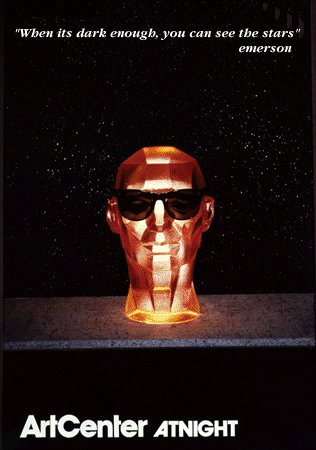
An Emerson quotation became a built, illuminated image for an ArtCenter at Night promotional poster.
Bob’s role
Concept, dimensional illustration and fabrication.
Give night a meaning beyond the schedule.
A promotional poster for ArtCenter at Night needed an image that connected evening study with the possibility of discovery. The starting point was the Emerson quotation printed on the poster: “When it is dark enough, you can see the stars.”
The creative opportunity was to make darkness part of the idea. Night could become the condition in which something previously unseen appears.
Make illumination physical.
Bob developed a dimensional head as the central image. A human form places thought and perception at the center of the composition; light gives that form its presence. The quotation and the object work together, connecting an act of seeing with the promise of creative education.
Build the image before making the poster.
The concept was realized with a fabricated resin head, concealed lighting and a hand-painted night environment. Rather than beginning with a digital composite, the image began as a built object: material, lighting and setting had to carry the idea.
- Translate language into form. Turn the quotation into a visual premise involving darkness, a human head and illumination.
- Fabricate and light. Create the resin form and conceal the lighting so the object itself becomes the focus.
- Build the environment. Establish a painted night setting that supports the illuminated figure.
- Resolve the poster. Bring the quotation, dimensional image and ArtCenter at Night identification into one composition.
One image, one connected proposition.
The finished poster places the quotation above the dimensional head and the program identification below it. The dark field gives the light room to register; the illuminated form provides the visual connection between the words and the school.
The result is a promotional piece in which concept, illustration and fabrication reinforce one another. Its enduring lesson is practical: a strong relationship between language and image can determine the material, process and final layout.