Governance
Founder principles, Production DNA and preservation standards establish purpose, authority and expected behavior.
Explore preservation standards →
PRODUCT THINKING · VISUAL INTELLIGENCE · CONTINUITY
A visual-intelligence framework connecting creative work with its decisions, history and trusted sources.
Bob’s role
Founder, platform direction, visual identity and creative methodology.
A finished artifact can survive while its history disappears. Conversations, sketches, files and decisions become scattered; the next contributor has to reconstruct what happened and which version to trust.
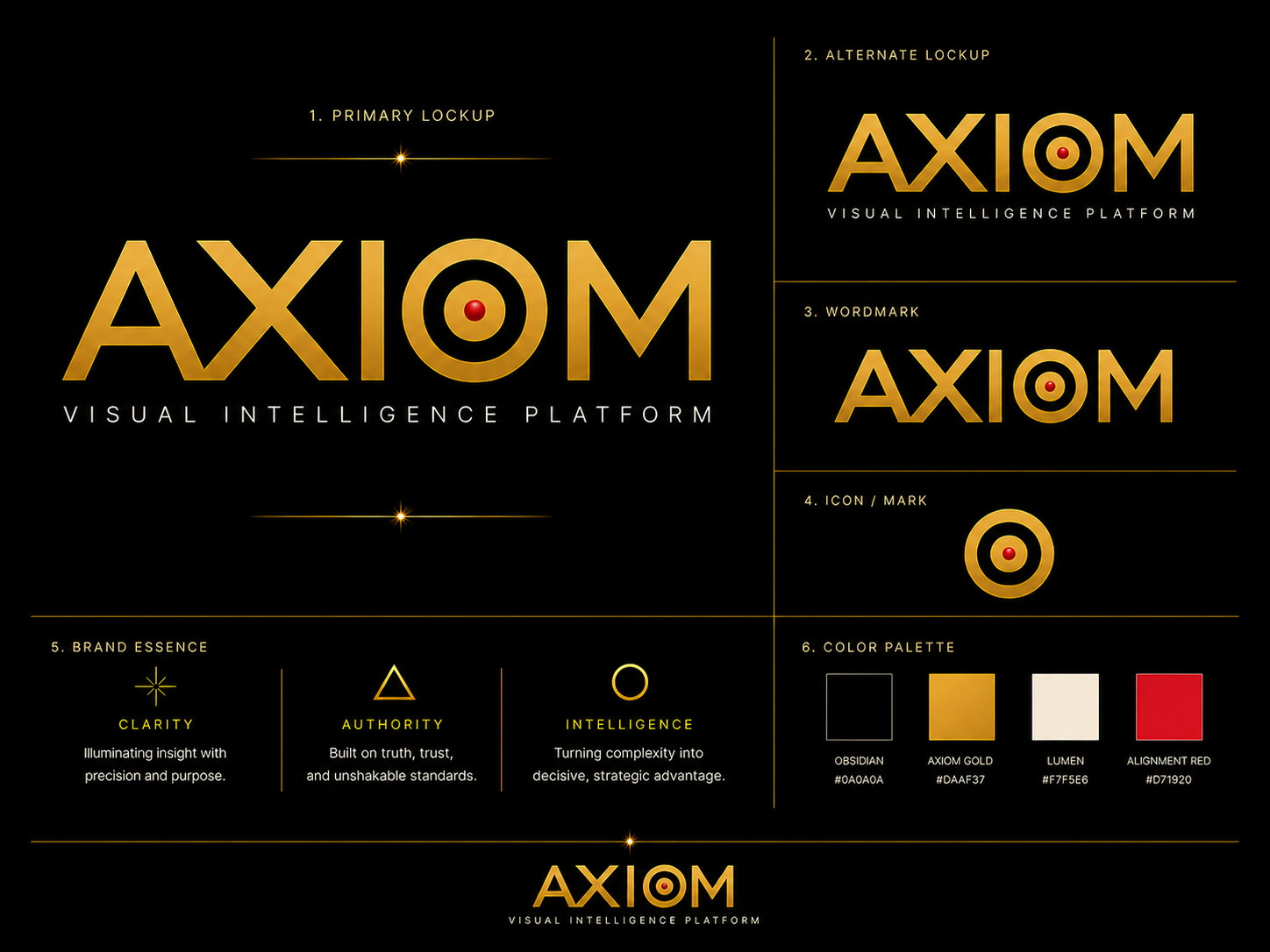
AXIOM begins with that continuity problem. Bob’s platform and methodology are designed to preserve the life of an idea: its identity, contributors, relationships, decisions and authoritative state.
The Enterprise Executive Introduction, Edition 3.5, defines AXIOM as a connected environment for projects, publications, archives, education and production. These disciplines share a need for identity, provenance and memory.
The design premise is that organizing work should help people understand it. Visual hierarchy, comparisons and visible relationships are part of the reasoning process, helping a creator move from observation to a useful next action.
Founder principles, Production DNA and preservation standards establish purpose, authority and expected behavior.
Explore preservation standards →The proposed Registry, Search, Knowledge Graph and Authority Repository identify, connect and preserve meaningful objects.
Read the architecture booklet →Creative Habitats, environmental memory and visible work surfaces are intended to support attention and comparison.
Explore the workspace concept →The framework places Bank Shot Buddy, Atlas Cue Academy and future tools in a wider ecosystem of practical uses.
Explore the applications →The Golden Seed Method turns a meaningful stage of development into a referenceable milestone. It brings together the approved work, revision history, authority assets, release notes and the context needed to resume.
Within the framework, an AXIOM ID gives an object persistent identity; provenance explains where it came from; authority distinguishes a trusted master; relationships explain how it connects to other work. These are design requirements for continuity, rather than information left to filenames or personal memory.
Bob’s earlier Front Porch concept imagined the studio as a house with rooms for making, remembering and discovery. AXIOM carries that environmental thinking into its principle of places before interfaces.
The Crit Wall and Living Wall are described as ways to keep active work visible so comparison and proximity can reveal relationships. The product direction is to make the system understandable before asking a creator to learn its underlying architecture.
The available work includes AXIOM’s visual identity, an executive introduction and a defined architecture and preservation method. These establish the product language and standards against which further development can be assessed.
This is an ongoing product and methodology case study. The architecture describes intended capabilities; it is not a claim that every engine is implemented or that enterprise performance has been measured. Its central contribution is a clear design proposition: creative work should carry enough context for the next person to understand, trust and build on it.